


2-minute read
What’s your take on this private credit freakout right now?
Uhmm, I’m not sure.
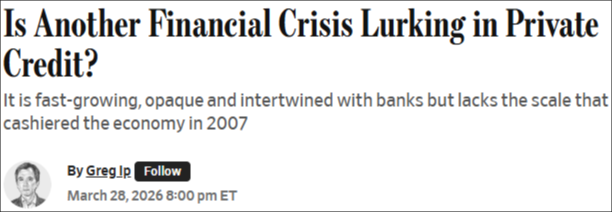
You had to have seen a gazillion headlines like this, no?[1]
Honestly, man, I have zero idea what private credit is.
That’s fair. Let’s run through a real-life example.
Please.
So you’re a successful business owner in the area. Business is doing well but you need a loan to take it to the next level. What would you do?
I’d call a bank.
Sure, that’s reasonable. But before you get in touch with the bank you get a call from your buddy Jeff. Jeff works for an investment firm in the area. Jeff lets you know that his firm issues loans to business owners.
Jeff’s a good guy and all, but loans from the local bank should work just fine.
Just hear him out. Jeff tells you that banks often take months to approve a loan. Banks slog through loan approval under the weight of government regulations. On the flip side, a loan from Jeff’s firm can be rubber stamped in weeks. Your business needs to move quickly. Why wait?!
I mean…
Also, Jeff reminds you that banks have covenants, often times strict covenants.
What’s a covenant again?
Your company must maintain a certain level of financial growth in order to stay in the bank’s good graces. If, for example, your profits dip in a year, they may consider the loan in default. Jeff’s firm offers more flexibility in times of financial distress.
That’s interesting.
Lastly, Jeff’s firm has expertise in your sector. His group better understands the risks of your business. The bank acts as a generalist with loans often issued to real estate purchases or retail endeavors.
Okay, we can hang up on Jeff now. I get it.
Now look up at the headline again. Any questions?
So why would private credit lead to a financial crisis?
Investors are able to invest in private credit funds. Private credit funds, run by investment professionals, take in money from investors and lend it out to private businesses. The businesses pay principal and interest on those loans. Then the fund passes most of that back to the investor. Make sense?
Yeah.
Concerns around private credit investments are growing. A chief concern is that rising interest rates lead to higher interest payments for these companies. Are we sure they can afford these?
Why don’t we take a look under the hood at the loans?
That hits upon another concern. There’s a lack of transparency around the loans. It can be difficult to know loan terms and the business’ financials. Investors rely on reporting from the investment firm that manages the fund.
Is there a lot of money invested in private credit funds?
$2.5 trillion globally. Its grown almost five-fold in a decade.[2]
Year | Private Credit Assets Under Management (AUM) |
2016 | $580 Billion |
2017 | $660 Billion |
2018 | $730 Billion |
2019 | $850 Billion |
2020 | $1.05 Trillion |
2021 | $1.21 Trillion |
2022 | $1.52 Trillion |
2023 | $1.75 Trillion |
2024 | $2.1 Trillion |
2025 | $2.5 Trillion |
What accounted for that growth?
That’s a story for a different time. The question is how concerned should we be?
You tell me!
To put things into perspective, the global stock market has $127 million in AUM. This is 50x the size of the private credit market.[3]
So it’s small potatoes?
I’m not at panic level 10 like some of the headlines you’ll see. However, it is possible that distress in private credit could spill over to main street. You’d see this in the form of fewer loans being issued to small businesses. If even profitable companies lose access to loans, growth could suffer and small business employment could as well.
Guess we’ll see if private credit becomes the next villain or if I forget what it is in 3 months.
I hope for the latter.[4]
_____________________________________________________________________________
[1] Source: https://www.wsj.com/economy/is-another-financial-crisis-lurking-in-private-credit-cad379b1
[2] Source: McKinsey Global Private Markets Reports, Preqin, and the Alternative Credit Council
[3] Source: https://www.sifma.org/research/statistics/fact-book
[4] Graphic created with the help of AI