


3-minute read
If I showed you this headline six months ago, what would be the first thing that came to mind?[1]

Uhh maybe a parade float mishap. Or perhaps a roundabout reference to the 1986 Cleveland Balloonfest?
One of the more bizarre geopolitical stories of my lifetime.
Between these recent Chinese espionage incidents and the Ukraine/Russian conflict, we’ve seen a steady stream of foreign political news.
I’m curious: does this make you second guess your ownership of international stocks? I know you’ve mentioned in the past that around 25% of your equities are international.
I don’t know. Should I be rethinking things?
Well, let’s start with recent history[2]:
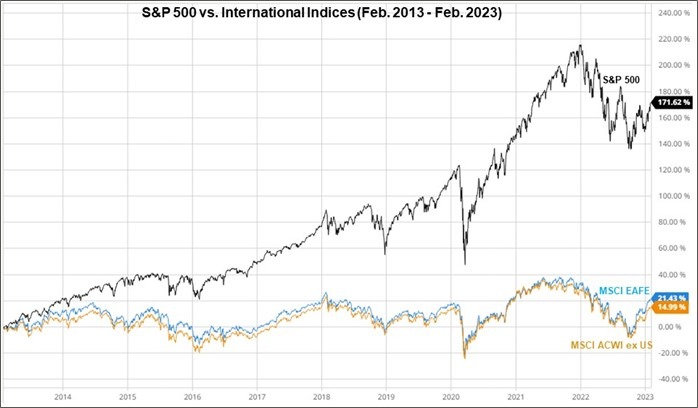
What are the MSCI EAFE and the MSCI ACWI ex US?
Those are commonly used international stock indices. The graph shows the total return for those and the S&P 500 dating back approximately ten years ago.
Looks like I should be rethinking things.
However, let’s check out 2022 returns[3]:
S&P 500 vs. International Indices (2022) | |
S&P 500 | -18.11% |
MSCI EAFE | -14.45% |
MSCI ACWI ex US | -16.00% |
So you want me to hold on to my international stocks after one year of outperformance where I still lost money? I can’t even remember the last time I heard international outperforming domestic.
It’s true. U.S. stocks have outperformed their international counterpart eight out of the last ten years[4].
Hitting the sell button in 3…2…
Hold your horses. Let’s dig a bit deeper. Take a look[5]:
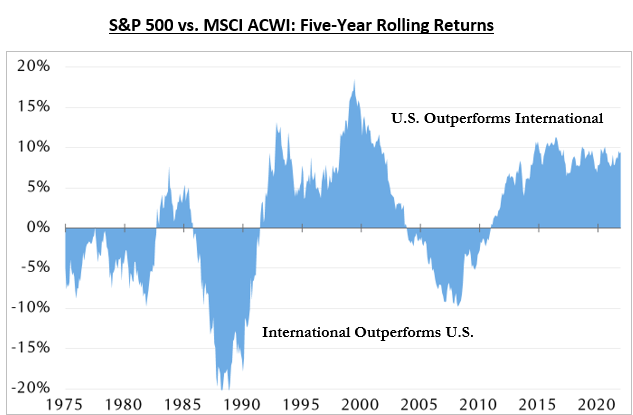
What’s this supposed to be?
It’s a comparison of domestic and international stock returns dating back to 1975. The top icebergs are periods of U.S. outperformance and vice versa.
So it’s been cyclical. Got it.
Interestingly enough, the cycles have somewhat matched up with periods of weakened returns from U.S. stocks. Check this out[6]:
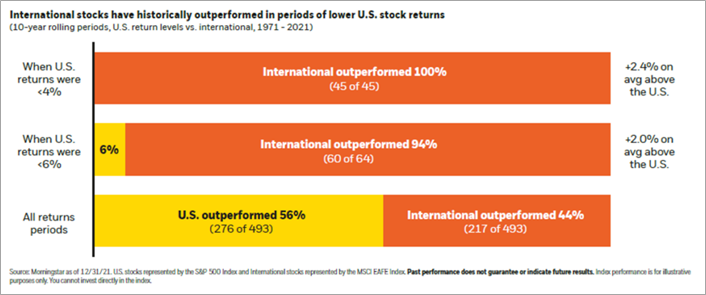
So if I’m someone who thinks domestic stocks may be in for a period of subpar returns, the case for international stocks could be even stronger?
Correct.
I get all this. But aren’t we at a point where our American companies have gotten even larger and more geographically diverse? India has over 400 million registered Facebook users. Coca Cola drives the majority of revenue from outside the U.S.
True. Corporations are becoming increasingly more global. The line between domestic and international is getting blurred.
So what would you consider to be an appropriate mix of domestic to international stocks in a portfolio?
This clearly differs by personal preference. However, I would refer to the global stock index as a starting point[7]. This allocation is 60% U.S. and 40% international. The 40% international is likely too heavy for most, but I would caution going below 10%.
Anything else?
Home country bias is nothing new. International crises, wars, etc. only add fuel to this fire. Having just a small allocation to international stocks is fine. Just remember to keep it a slice of the pie. Stay cultured.
[1] Vivian Wang, “China, Still Trying to Play Down Balloon, Finds It’s Getting Harder to Do,” 2023, https://www.nytimes.com/2023/02/10/world/asia/china-spy-balloon.html
[2] Index data sourced from www.spglobal.com and www.msci.com
[3] Index data sourced from www.spglobal.com and www.msci.com
[4] S&P 500 versus MSCI EAFE.
[5] Chart sourced from: https://www.rbcwealthmanagement.com/en-us/insights/u-s-vs-international-equities-time-for-a-portfolio-tune-up
[6] Chart sourced from: https://www.blackrock.com/us/financial-professionals/literature/investor-education/why-bother-with-international-stocks.pdf
[7] Global stock index: MSCI ACWI.