Are you a man of values, Mr. Johnson?
I’d like to think so.
Do you apply these values to several areas of your life?
I try to at least.
Do you try to apply them to all that you do?
I think…wait, what’s going on? When did Elliot Stabler join the conversation?
I happened to come across this headline a few months back. You see this as well?
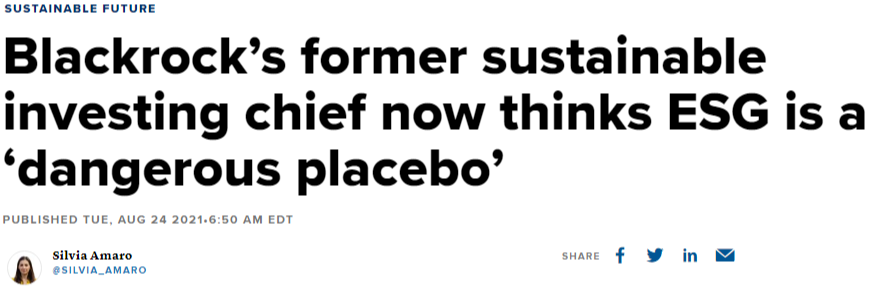
I did not. What’s ESG all about?
ESG stands for Environmental, Social, and Governance. It refers to a style of investing that incorporates an individual’s personal beliefs and values. SRI, or Socially Responsible Investing, is a synonymous term you will also see.
So why does BlackRock’s former exec think it’s a ‘dangerous placebo’?
Well, let’s take a step back first. Let me flesh out ESG investing a bit.
Go ahead…
ESG investing is an attempt to evaluate corporations based on their social and environmental impact. The objective is to shun companies related to things like oil, firearms, and gambling while supporting companies involved in social justice and environmental sustainability.
So like Tesla would be a good example of an ESG-approved stock?
Well, kind of…
Seems to fit the ESG mold to me.
Certainly, the lack of CO2 emissions from a Tesla or electric vehicles (EVs) in general is a positive for the environment. But you could make the argument it’s not an entirely green process.
How so?
Several minerals – lithium, graphite, cobalt – are used to build a Tesla’s battery. Extracting these minerals from the earth isn’t exactly a “green” process. Not to mention their new showroom in the Xinjiang region of China and the social issues associated with that.
Hmm, fair point. How about something like Pfizer? They just developed a vaccine that helped save millions of lives. Quite the social impact, eh?
Absolutely, the speed at which the vaccine was developed was a massive win for humanity.
I’m sensing a “but…”.
Some have argued that Pfizer should waive their patent protection on the grounds that it would help low-income nations boost their vaccination rate. This then bleeds in to the “Big Pharma” conversation which is a whole ‘nother bag of issues.
So is any company entirely ESG/SRI friendly?
Not that I am aware of. Various firms, including money managers themselves, have developed methodologies to evaluate companies using certain criteria.
So different evaluators define ESG on their own terms? Seems like an issue to me.
I’d agree
And has the confusion around this led to investor hesitance?
You tell me:
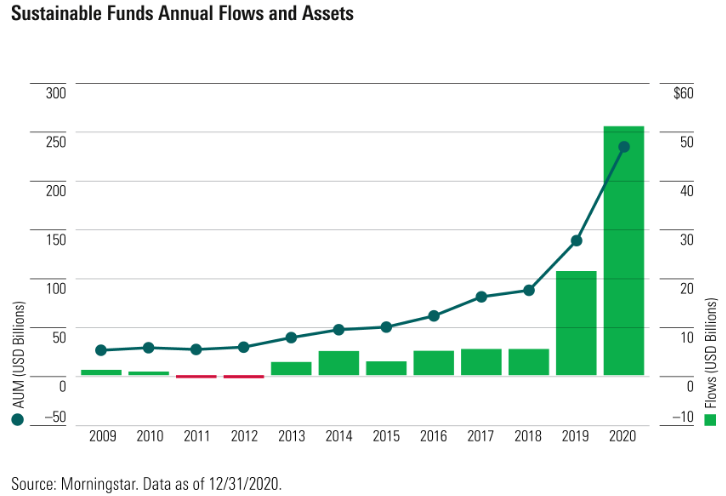
Looks like they have a good thing going.
Clearly, the popularity of these funds has taken off.
And from the sound of it, you are not on board?
I wouldn’t say that. I believe that investors should have the option to integrate their values into their investing. The overall mission is a sound one.
So, what’s your beef?
For one, the aforementioned issue with the definition of ESG. While we may never arrive at a universal set of criteria, a bit more uniformity would be nice.
I have my doubts we’ll ever get to a singular definition. What is “green” and “socially responsible” will differ from one person to the next.
I agree – a universal definition may never come. And that is exactly why we need tools that allow people to customize their portfolio around their values.
Do these tools exist?
Not to the masses. Direct indexing is a recent trend that allows you to mirror an index while excluding stocks that conflict with your values. For example, if you don’t like the legacy oil companies but have no issues with defense firms, then you can mold the index fund accordingly.
What should we do in the meantime while these kinds of tools are being democratized?
The current ESG offerings are still a good place to start. My advice, however, would be to research the product beforehand. Do not take the marketing at face value because that could lead to eventual surprises. Read up and do your best to know exactly what you are investing in.
Just My Afterthoughts
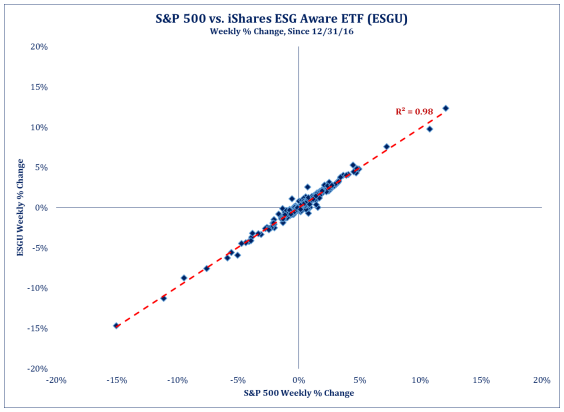
Check out the chart below that compares the performance of the S&P 500 and a popular ESG ETF called the iShares ESG Aware MSCI USA ETF (ESGU). An investor in the ESG fund would hope that the exclusion of non-ESG friendly stocks would boost performance. When you dig deeper, though, one will see that the makeup of these funds is quite similar. In fact, the performance over the past 5 years has a correlation of 98%. The reason? This ESG fund removes the energy stocks which make up a whopping 2% of the S&P. Their exclusion, therefore, has little impact.