


3-minute read
If I’ve seen this headline once, I’ve seen it a thousand times in the past couple of years[1]:
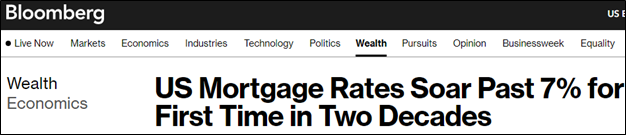
At least it’s not a debt ceiling headline. My eyeballs were starting to burn from those.
The housing market has really had its day in the sun. Don’t remember a time when I talked about it this much.
Do you know anyone trying to buy right now?
Sure do.
They gotta be nuts.
Do they?
Uhhh yeah! Mortgage rates at 7%?! They have to fall sooner or later.
Do they?
If they don’t, the housing market will be at a standstill for quite some time.
Possibly, but what if I told you that current rates are not that high?
I’d show you my mortgage at 3.25% and tell you to kick rocks.
That’s completely fair. But just check this out for a second:
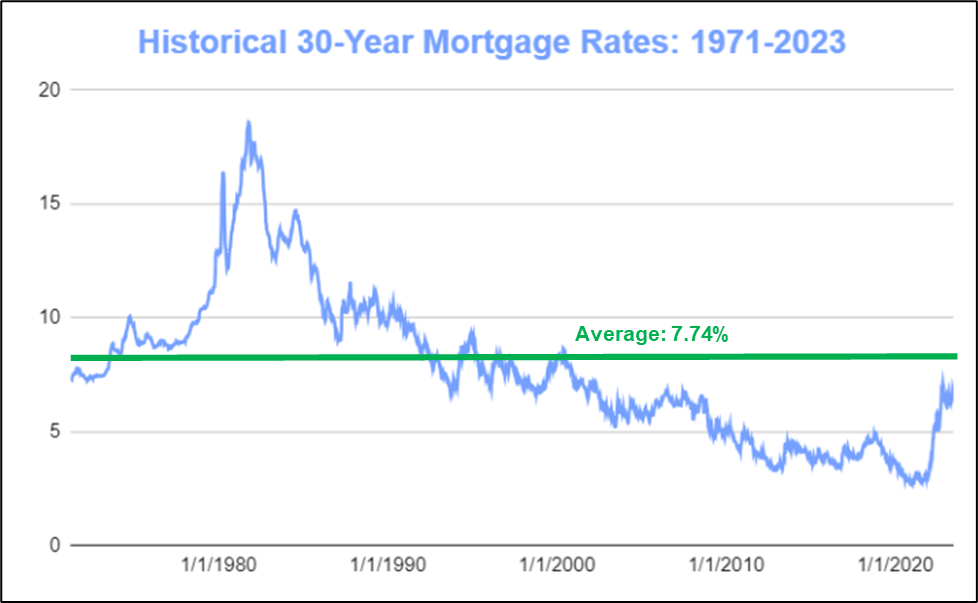
Those poor boomers in the ‘80s.
Yes, they had it rough. Almost the entire decade saw rates at double-digit percentages.
And then the 2010s came around and the script was flipped. Rates below 5% for 10+ years.
A global recession will do that to you.
Speaking of recession, aren’t we barreling towards one? Won’t that bring down mortgage rates like it did in the 2010s?
It’s a decent bet. However, keep in mind that: (1) a recession isn’t guaranteed and (2) we don’t know the severity of it if it does hit.
I don’t know, man. I’d put my money on it.
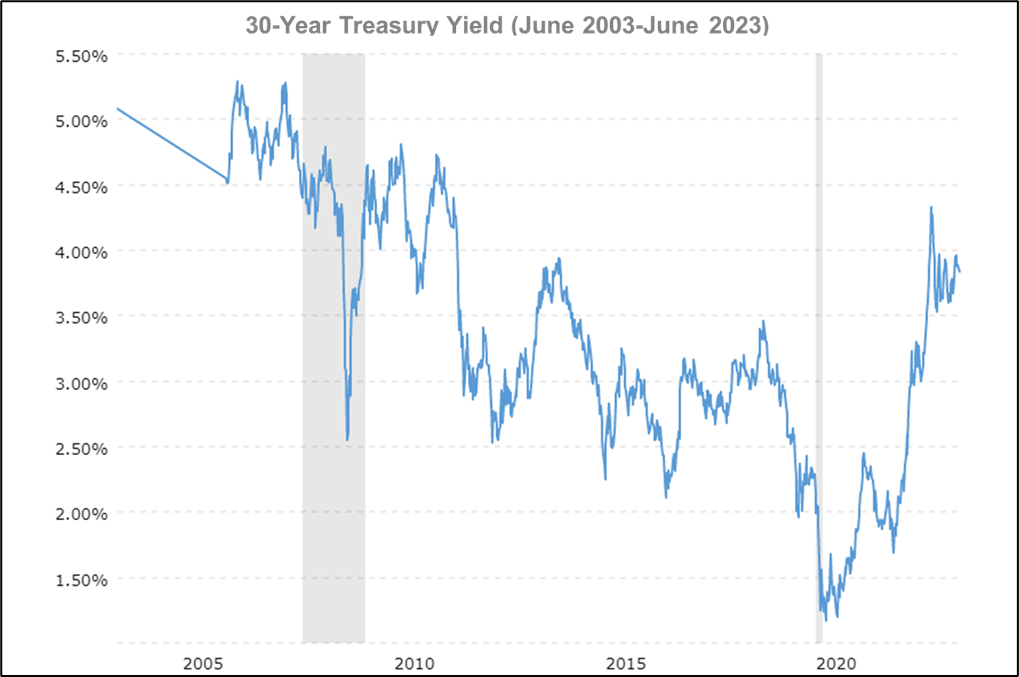
I may too. But take a look at this chart:
What’re we looking at?
This is a chart of interest rates over the past 20 years.[3] Interest rates largely dictate mortgage rates along with several other economic/market metrics (bond returns, auto loans, business development, etc.).
And the point you’re trying to make is…?
My point is that guessing the forward path of interest rates is very difficult. You could argue they are harder to predict over the long haul than the stock market.
I think you’re insinuating that interest rates will stay high for a while.
I have no idea. My point is that we shouldn’t assume rates will fall to pre-2022 levels anytime soon. This high-er rate environment could be here to stay for 5, 10, 15 years.
That would suck.
Certain aspects of it, yes. Mortgage payments would be higher, businesses may be less prone to investing in themselves, other forms of debt are more expensive.[4]
Lovely…
It’s not all bad, though. CDs pay a higher risk-free rate, bonds produce more interest income, the dollar goes further abroad, and Social Security/pension payments increase.[5]
I guess I could get used to a 6-month CD yielding 5%.
The net effect will be situational. Interest rates – and the economy at large – will never be a positive for all people at all times. It’s important to realize the unpredictability of rates and how they affect your life.
______________________________________
[1]https://www.bloomberg.com/news/articles/2022-10-27/us-mortgage-rates-soar-past-7-for-first-time-in-two-decades#xj4y7vzkg
[2] Chart represents weekly averages for a 30-year fixed-rate mortgage. Average for 1971-2023 as of June 15, 2023. Source: Freddie Mac PMMS. (c) TheMortgageReports.com.
[3]https://www.macrotrends.net/2521/30-year-treasury-bond-rate-yield-chart
[4] Increased interest payments on our government debt is another looming issue around higher interest rates. That deserves its own blog post.
[5] Pensions with a cost-of-living (COLA) adjustment are likely to increase.